How to spot rail spur access in satellite imagery
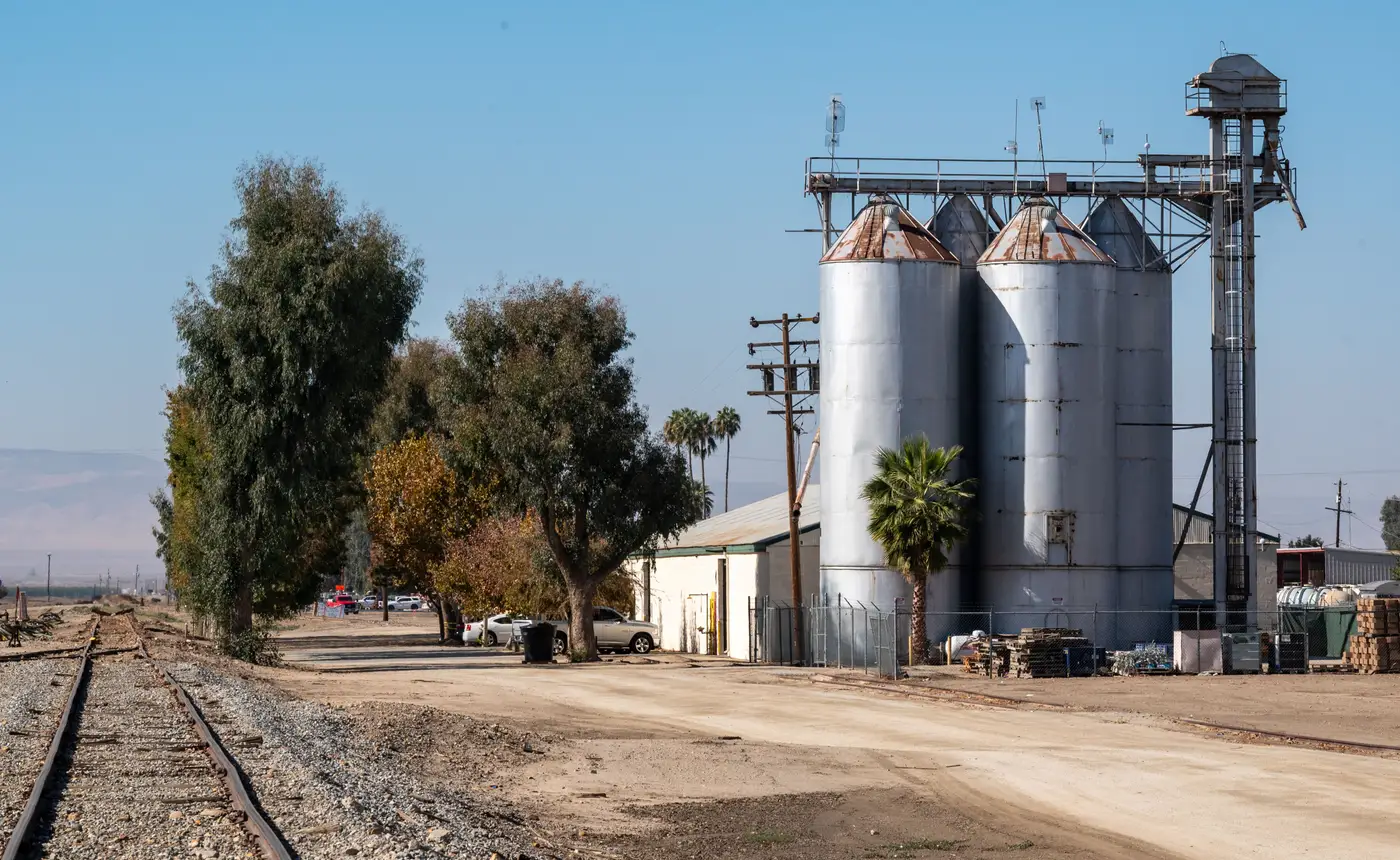
A broker listing says "rail-served." A county GIS parcel shows a thin line crossing the back third of the lot. Neither one tells you whether that spur still carries a car, or whether it's been sitting unused since the tenant that justified it closed down. Before you burn a trip out there, a satellite pass can answer most of that from your desk.
What a working spur actually looks like from overhead
A spur reads as a straight or gently curved line departing the mainline at a shallow angle, almost never a sharp turn. Rail can't take tight curves, so if what you're looking at bends like a driveway, it's probably gravel or a service road, not track. Ballast shows up lighter than surrounding soil or asphalt, a pale gray-white band a few feet wide, and it should look clean and continuous the whole run from the switch to the dock or team track at the end.
Scale matters here. At 0.5 m resolution you can follow that ballast band, count how many car-lengths of straight track sit inside the parcel line, and see whether it ends at an actual loading apron or just stops in weeds twenty feet short of the building. That last detail kills more "rail-served" listings than anything else. A spur that doesn't reach the dock is a spur that needs capital before it's useful to you.
Spur track condition: active, idle, or dead
Vegetation is the tell. A spur that's moved a car in the last season has bare or lightly grassed ballast between the rails, because weight and vibration keep growth down. An idle spur gets a green stripe down the center, grass or brush growing between the ties even though the rails themselves are still visible. A dead one disappears entirely under scrub, or the ballast band breaks up where ties have rotted and sunk.
Switches are the other giveaway. A maintained turnout has a clear, unobstructed throw area, visible as a small triangular clearing where the points are. If that area is overgrown or the switch stand itself can't be picked out from the clutter around it, assume the connection hasn't been thrown in a while, whatever the listing claims. None of this tells you if the switch is locked, bonded, or whether the serving carrier will even still spot cars there. That's a phone call to the short line or Class I, not something a pass can settle. But it tells you whether it's worth making that call before you drive two hours to look at a parcel with grass growing over the rail.
Rail-served parcel vs. intermodal-adjacent: not the same claim
A site a half mile from an intermodal ramp gets marketed as rail-advantaged all the time, and for truck moves to and from that ramp it might be. But "near an intermodal yard" and "has a spur onto the parcel" are different facts, and only one of them means you can spot a car at your own dock. Confusing the two is how a network team ends up under contract on a building with great intermodal access and zero actual rail access, discovering the gap at the engineering review instead of the shortlist stage.
The fix is just checking both things separately before anything else gets scheduled: does a spur physically enter the parcel boundary, and separately, how much rail and logistics activity sits in the surrounding area. One is a yes/no on the lot itself. The other is context on whether the corridor is worth the premium.
Pulling both reads together is what Distribution Siting does for a shortlist: a land-cover and access read on each candidate parcel, plus a count of nearby logistics activity, from a satellite pass you request on demand rather than whatever archive image a listing happens to use. It won't tell you who the serving carrier is or what the switch fee runs, but it will tell you whether there's a real spur worth asking about in the first place.
If you've got five candidate parcels and only budget to visit two, that's the question worth answering first. Run the shortlist through a site read before you put any of them on the calendar.