How to tell a vacant industrial building from an occupied one
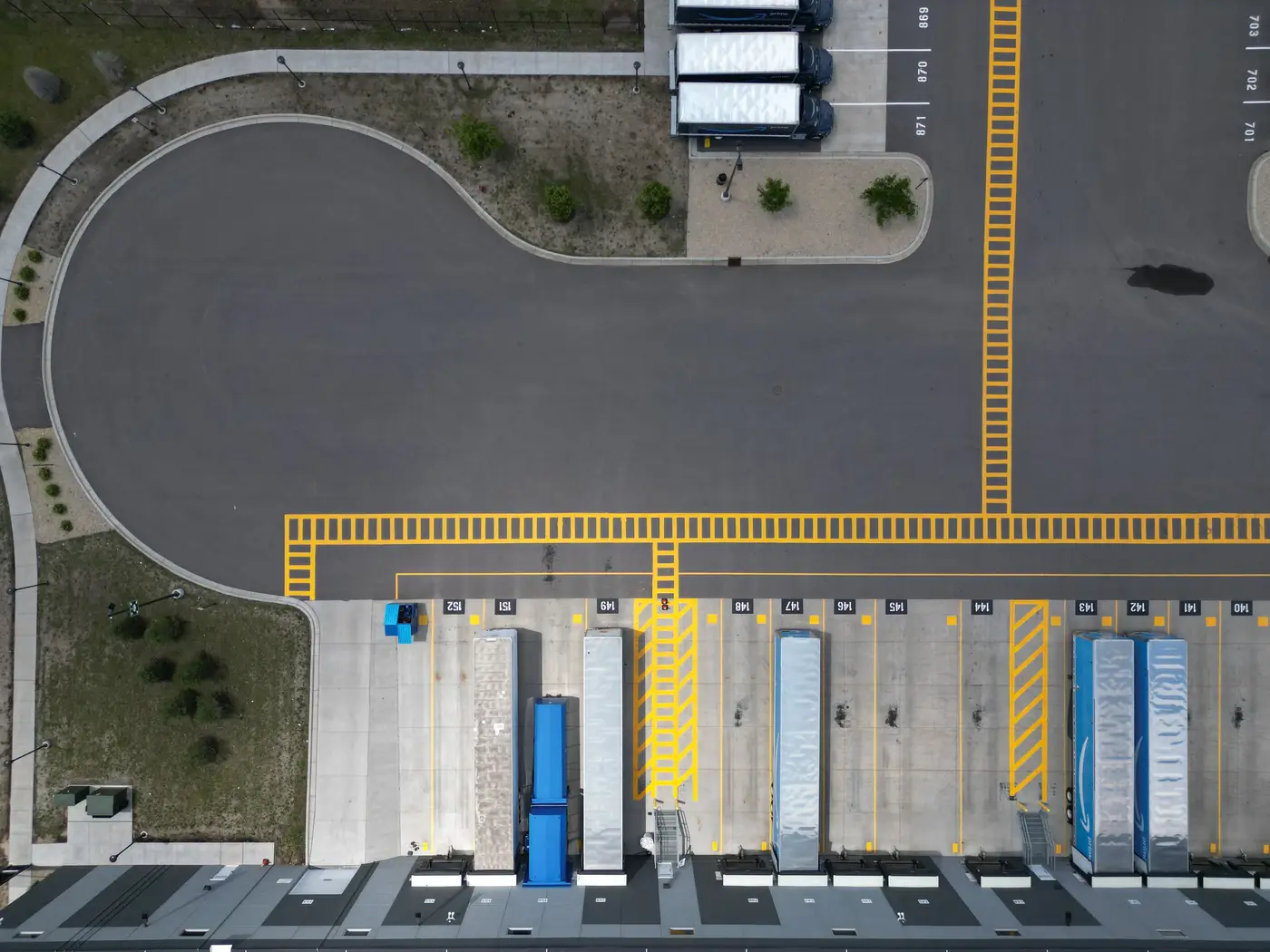
A county assessor record says "occupied." A broker listing says "available." Neither one is reliable by the time you're building a shortlist, because occupancy data lags the real world by months and nobody updates it when a tenant quietly walks out mid-lease. Before you spend a travel day confirming what a building is, a sub-meter satellite pass gives you enough to rule a chunk of the list in or out from a desk.
The tells that show up at 0.5 m resolution
At 0.5 m or finer you're not reading a rooftop silhouette, you're reading what people and trucks left behind on the ground. A few things worth checking candidate by candidate:
- Truck court wear. Dark, repeated arcs in the pavement where trailers swing into dock doors mean regular turns. A truck court with faded striping and no wear pattern at all usually means nobody's backed a trailer in for a while.
- Trailers on site. Staged trailers at the dock, even unhitched ones parked along a fence line, are one of the cleaner occupancy signals you'll get from an overhead pass.
- Parking lot fill. A near-empty lot on a weekday daytime pass, next to a building sized for a few hundred employees, is worth a second look. Compare the fill against the lot's striping capacity to judge how empty it really is.
- Vegetation creeping into pavement. Weeds through expansion joints or grass growing up against a dock door tell you maintenance stopped, which tells you occupancy probably stopped first.
- Rail spur condition. If the candidate has rail service, look at the rail itself. Rust-colored rail means it isn't being run on. A polished strip down the center of the ties means cars are moving.
- Roof condition. Ponding, missing panels, patch repairs in a different material than the rest of the roof. Owners maintain roofs on buildings that are making them money and let them go on ones that aren't.
None of these signals is proof by itself. A trailer could be a dropped unit nobody's hooked up in a year. A clean lot could just be a Sunday pass. Taken together, though, they shift the odds enough to decide which parcels get a drive-by and which don't.
What a satellite pass can't tell you
There's no thermal band on this kind of pass, so you can't read heat off a roof to confirm an HVAC system is running or a cold room is holding temperature. That's the gap between "looks vacant from the pavement wear" and "confirmed vacant." For a cold-chain candidate specifically, that gap matters more, since a dark, cold-looking building might just be a well-insulated one running fine. Treat the imagery read as a filter that narrows the list rather than a verdict on any one site.
What this looks like across a shortlist
A single building's vacancy tells don't settle whether the parcel is worth pursuing. Check the land cover around the building before assuming the lot is pad-ready, count how much active logistics activity sits nearby, and look at whether the road in is built for trailer traffic. Distribution Siting pulls a high-res pass on demand for each candidate parcel and returns a land-cover and access read alongside a count of nearby logistics activity, so the occupancy guesswork above sits next to those other reads instead of standing alone.
If you're sitting on a list of candidate parcels and trying to figure out which ones are worth a travel day, run them through a pass before you load the truck.