What is a reefer trailer turning radius, and why it shapes your site layout
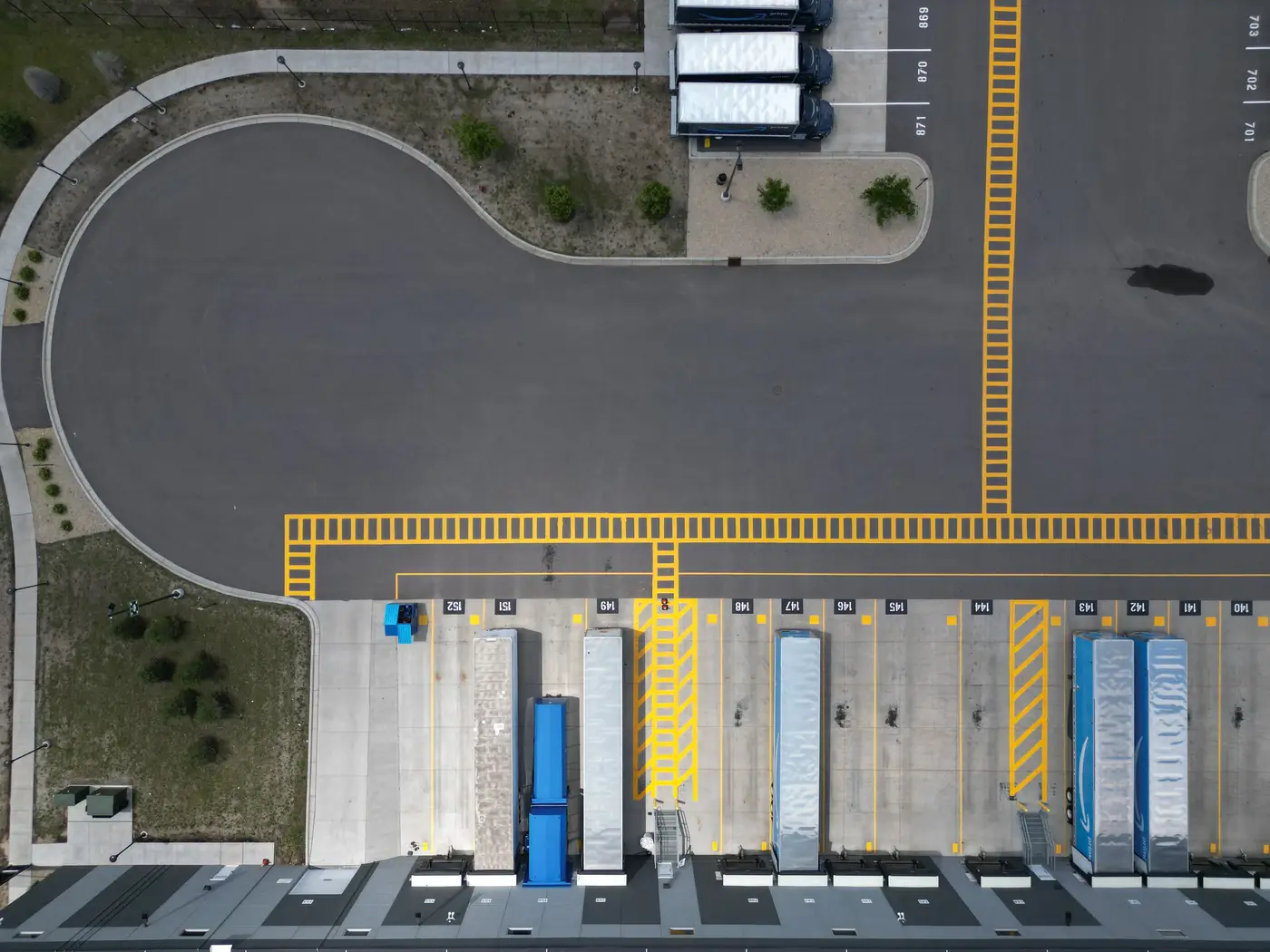
A reefer trailer turning radius is the amount of swept path a loaded 53' refrigerated trailer, pinned to a tractor, needs to complete a turn without the trailer tires jumping the curb or the nose clipping a building corner. It's not one number. It changes with trailer length, tractor wheelbase, the kingpin setting, and whether the driver is running a sweeping pull-through turn or backing a trailer into a tight dock apron at 2 a.m. in the rain.
Most site plans lean on AASHTO's WB-62 or WB-67 design vehicle templates to model this. A WB-67 (a 67-foot overall tractor-trailer combination, which covers most reefer units on the road today) needs roughly 45 to 50 feet of turning radius at the outside wheel path for a 90-degree turn, and a lot more apron depth if the maneuver is a back-in rather than a drive-through. On paper that's a line on a CAD drawing. On a real parcel, it's the difference between a trailer sliding into a dock bay on the first pass and a driver jackknifing in a parking lot while six other trucks queue behind him.
Why this matters more for cold chain than dry freight
A dry freight dock can tolerate a little inefficiency. A late trailer costs you a missed appointment. A cold-chain dock can't absorb the same slop. A reefer unit idling outside a bay because the truck court is too tight to back in cleanly is a trailer burning diesel to hold temperature while product sits. Multiply that by a dozen trailers a day at a distribution center running frozen or chilled freight, and a bad turning radius stops being a traffic annoyance and starts showing up as fuel spend, driver turnover (nobody wants to work a yard that takes four pull-ups to land a bay), and in the worst cases, temperature excursions that get flagged at receiving.
Reefer trailers also tend to run in tighter clusters than dry van freight at a cold storage or 3PL site, because precooling, genset charging, and dock staging all happen in the same yard footprint. A truck court serving reefer freight has to handle one trailer turning while two or three others sit parked or queued nearby, and that crowding eats into the clearance a single-vehicle template assumes.
What to check on a parcel before it goes further
A few things worth confirming before a candidate site moves past the shortlist stage:
- Apron depth. A back-in bay generally wants 120 to 130 feet of unobstructed apron from the building face to the far side of the drive aisle, more if the site uses 90-degree dock angles instead of a sawtooth layout.
- Drive aisle width. Two-way truck circulation typically needs 60 feet of clear aisle; one-way can run tighter, but only if the site's ingress and egress are actually set up to enforce one-way flow.
- Corner geometry at the parcel's access points. A tight radius where the site driveway meets the frontage road forces a wide swing that can put part of the trailer into an oncoming lane, which is a problem local DOT review will catch before you do if you don't catch it first.
- Column spacing and canopy clearance, if the building has an existing dock canopy, since a reefer tractor with a raised exhaust stack needs more vertical room than a dry van tractor in some configurations.
None of this is visible from a listing photo or a parcel map pulled off the county GIS site. It's the kind of thing that used to mean driving to every parcel on a shortlist with a tape measure and a set of turning templates before ruling anything out.
Distribution Siting exists for the step before that drive: a high-res satellite pass over each candidate parcel, pulled on demand, that reads land cover, road access, and nearby logistics density so a longer shortlist gets cut down before the windshield time gets spent on sites that were never going to work.
If you're sitting on a stack of candidate parcels and want the obvious misses screened out first, that's the use case this site is built around.